


One Rubbed Wire, Five Fault Codes – 2016 Mazda BT-50 Diagnostic Case Study
Modern vehicle faults rarely arrive with a neat label pointing directly at the failed component. This 2016 Mazda BT-50 is a good example: multiple systems reported faults, the transmission appeared to be failing, and the vehicle could intermittently enter limp mode or refuse to start. The eventual cause was not a transmission, turbocharger or control module. It was one chafed wire hidden beneath the battery.
The customer complaint
The BT-50 had intermittent limp-mode operation, harsh gear engagement and shifting, and at times a crank-no-start condition. Because the symptoms involved both engine and transmission operation, the first challenge was separating the primary fault from the secondary faults being reported by other control modules.
The initial fault codes

A full vehicle scan revealed several faults across the engine, transmission and ABS systems: P0674 glow plug circuit open, P042F EGR control stuck closed, P2564 turbocharger boost control position sensor circuit low, P2566 turbocharger boost control position sensor circuit intermittent, P0700 transmission control system MIL request, and U0401 invalid data received from the engine controller.
That list could easily lead to parts swapping: a turbo actuator, EGR valve, glow-plug controller or even transmission components. However, several modules reporting invalid engine data suggested a shared electrical or communication problem rather than a collection of unrelated component failures.
The misleading transmission symptoms
The harsh shifts and limp-mode behaviour made the transmission look guilty. But P0700 is not a diagnosis by itself; it means the transmission controller has requested the engine warning light. The U0401 faults were another clue that the transmission and ABS modules were reacting to unreliable information coming from the engine management system.
Live data exposed the electrical dropout
The turbo actuator position data became a key lead. During normal operation the reading was approximately 78 percent. When the fault occurred, it dropped suddenly to about -0.05 percent. That was not the gradual response expected from a mechanical turbo fault. It looked like the actuator or its reference circuit had abruptly lost electrical supply or signal integrity.
The blown F25 fuse
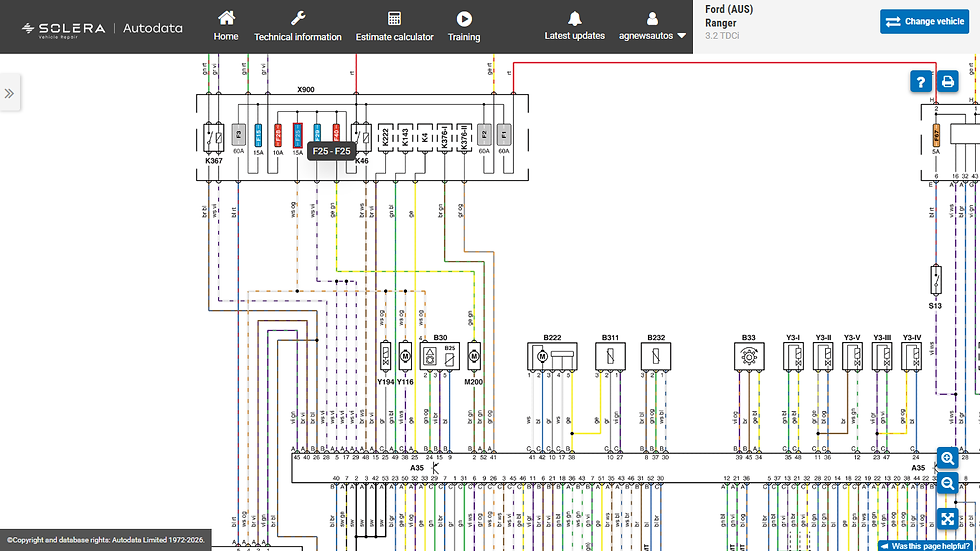
When the vehicle became a crank no start, inspection then found the F25 fuse blown. Replacing a fuse without finding why it failed is not a repair. The wiring diagram showed that the fuse supplied circuits capable of explaining several of the apparently unrelated engine faults, so the next step was to locate the short rather than fit components named by the fault codes.
Oscilloscope testing and the wiggle test

An oscilloscope was connected so the circuit could be monitored dynamically. The wiring loom and connectors were then moved methodically while watching for voltage or signal interruption. This approach reproduced the fault and narrowed the problem to the harness running beneath the battery area.
The actual fault, one chafed wire!

With the battery and surrounding components removed, a wire was found rubbed through beneath the battery tray. Movement allowed the damaged conductor to intermittently interrupt power supply enough to trigger faults and eventually short, blowing the F25 fuse and removing supply from multiple engine-control circuits.
The repair

The damaged section of wiring was soldered, insulated and protected, and the loom was secured so it could no longer contact the area that caused the chafing. The blown fuse was replaced, the fault codes were cleared, and the vehicle was retested through the conditions that had previously produced the fault.
The result
Turbo actuator data remained stable, the engine and transmission modules communicated correctly, and the limp-mode, harsh-shift and no-start symptoms did not return during testing. One wiring fault had created a chain reaction across several vehicle systems.
Fault codes identify the circuit or system that noticed a problem. They do not automatically identify the failed part.
Why proper diagnosis matters
Replacing parts based only on the code descriptions could have produced a large bill without fixing the BT-50. The successful diagnosis came from looking at the relationship between the codes, checking live data, understanding the shared power supply, and proving the failure with an oscilloscope and controlled wiggle test.
At Agnews Auto Services, our aim is not to guess which part might be faulty. We test the system, identify the cause and repair the actual problem. That is how a vehicle with what appeared to be engine, turbocharger, transmission and ABS faults was fixed by repairing one wire.
Agnews Auto Services – Woodville, New Zealand. Everything leaves better than it came in.
Comments